

Animated SBAR Practice Scenarios
Silent animated bedside scenes for SBAR practice. The scene gives the facts; the learner supplies the words.
Throughout, the whiteboard reads: post-op day 1, bowel resection, and the hourly urine output. An IV line runs from his arm to an infusion pump. At 14:00: heart rate 88, blood pressure 118 over 72, respiratory rate 16, oxygen saturation 97 percent, temperature 99.3 degrees Fahrenheit, urine output 45 milliliters per hour. He is resting with his eyes closed and breathing slowly and easily. At 16:00: heart rate 104, blood pressure 104 over 64, respiratory rate 20, oxygen saturation 95 percent, temperature 100.6 degrees Fahrenheit, urine output 25 milliliters per hour. He is awake and tired, with flushed cheeks, light sweat on his forehead and one hand resting on his abdomen. He is breathing faster. At 18:00: heart rate 118, blood pressure 92 over 54, respiratory rate 24, oxygen saturation 93 percent, temperature 101.5 degrees Fahrenheit, urine output 15 milliliters per hour. He is flushed and sweating, with his mouth open and one hand pressing on his abdomen. His breathing is fast and labored.
Case 1Postoperative deterioration
Your call
You are the nurse caring for Mr. Tolliver, 66, on a surgical unit. Phone the on-call surgical resident, who does not know him.
Give a 45 to 60 second SBAR update: what has changed, your concern, and a clear request.
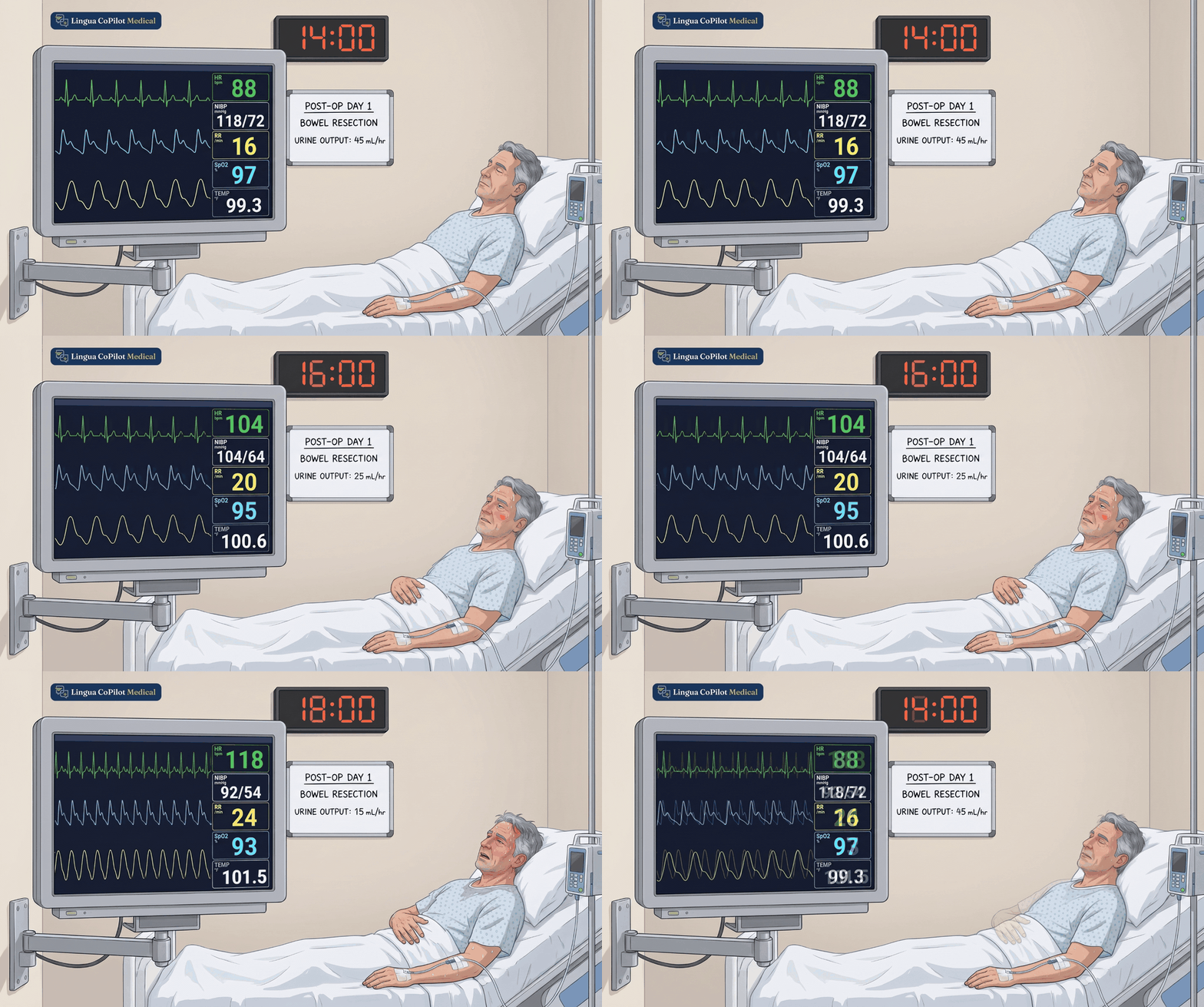
Free to use in your own teaching.
Instructor notes
- Two ways to run it
- Hold the scene on 16:00 and ask "Would you call now?", or hold it on 18:00 for the escalation call. A partner plays the resident, repeats back what they were asked to do, and the caller gets one retry.
- Not a test of diagnosis
- The scene shows a patient getting worse after surgery, not why. "I am worried he is deteriorating. I need you to assess him now." is a complete assessment and request.
- The time points are teaching checkpoints
- They are not a model of waiting two hours between assessments. Consider the trend and the patient's condition alongside your local escalation criteria. Use your institution's escalation pathway; the SBAR call does not replace emergency-response activation.
- What the scene leaves out
- Lab results, pain scores and the abdominal exam are not shown. If a learner asks, supply a value or say it is not available yet. Urine output is measured hourly from a urinary catheter that is out of frame.
- Limits
- The patient is fictional. This is formative practice, not clinical guidance and not a validated assessment.
SBAR structure: AHRQ TeamSTEPPS SBAR tool
More cases are planned
This page will grow. If you need a case built around your own unit or curriculum, email us what you teach.